
Usually when a plant has the word “weed” as part of it’s name, it doesn’t immediately attract itself to the typical gardener as a good candidate for their landscape. But this is one of those that should be given a second look.
Continue reading Narrow Leaf Milkweed (Asclepias fascicularis)


 Garden Sage is an all-in-one plant offering both looks as well as functionality. Spires of tubular, lavender colored flowers sit above a sea of grey-green and fragrant leaves in masse each spring. And of course, those leaves become a tasty addition for your kitchen spice rack.
 This is probably the least troublesome plant that I have in my garden, as well as the most spectacular. Not only do people stop and gawk, but the bees are happy to see them, too.
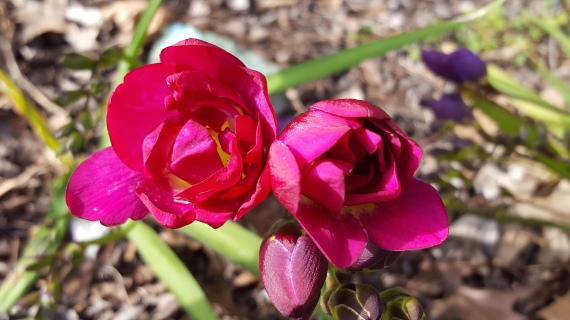 Each spring I eagerly await the appearance of my freesias. Their sweet aroma greets me every time I walk outside and their bright blooms are some of the first spots of color I see.

 It is easy to understand why Persephone was tempted by the pomegranate seeds offered to her by Hades, as told in the ancient Greek mythological story, even though eating them would condemn her to spend three months of each year in the dark underworld.
 I have a lot of pictures of this plant, and for a good reason. Starting in mid-summer into early fall it is enshrouded in a cloud of deep-blue flowers with a halo of pollinators all around.
 You know, a recipe typically calls for 1 to 2 bay leaves. Then you do another dish, and another. Those leaves start to add up. They aren’t cheap. Growing your own is.

 Mostly Greek